

Differences in weight loss results are primarily driven by a combination of your unique genetic makeup and clinical factors like dosage and treatment duration. Specifically, variations in genes that control how your body responds to these medicines can determine if you lose more weight or experience more side effects while managing obesity.
The Satiety Connection: The NBEA Gene
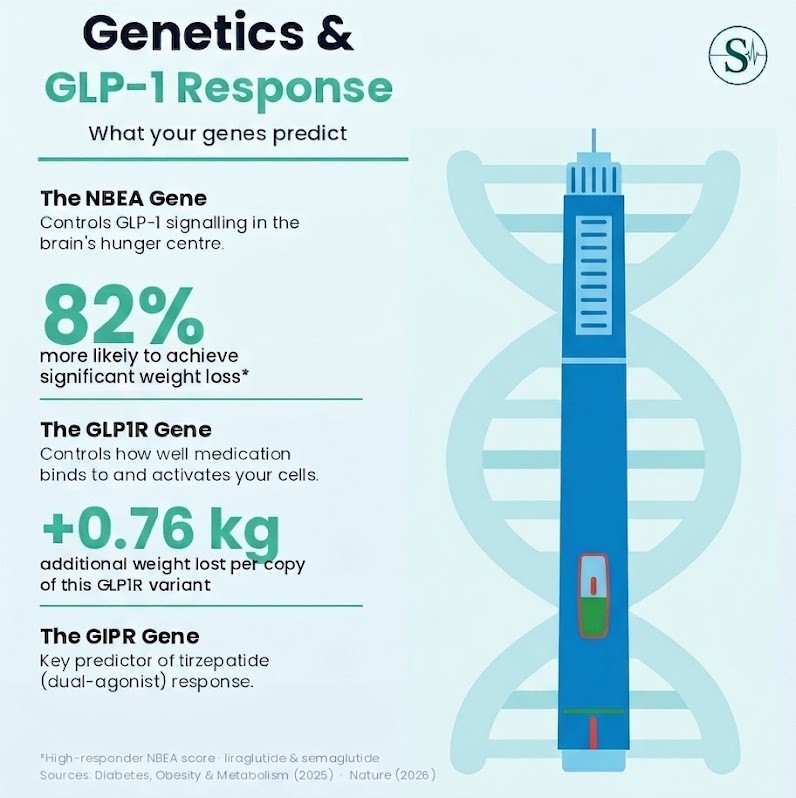
Research has identified a novel genetic predictor called Neurobeachin (NBEA). This gene encodes a protein that helps anchor enzymes responsible for GLP-1 signalling in the brain, particularly in the hypothalamus—the area that controls hunger.
Researchers at the Cleveland Clinic studied over 6,500 patients and found that the NBEA genetic score is a powerful indicator of success:
- High Responders: Individuals with a “responsive” NBEA score are 82% more likely to experience significant weight loss on medications like liraglutide and show significantly better results on semaglutide.
- Non-Responders: Conversely, those with a “non-responsive” NBEA score are 50% more likely to lose no weight at all on liraglutide.
- The “Fullness” Factor: Variants in the NBEA gene are also linked to “early satiety,” or the feeling of being full sooner, which is a critical mechanism for how these drugs work to treat obesity.
How Genes Affect Your Response to GLP1s
While NBEA influences how full you feel, other genes determine how well the medication actually binds to your cells. Recent large-scale research published in Nature involving nearly 28,000 patients has identified specific genetic variants that act as “predictors” for how well a person responds to GLP-1 medications like semaglutide and tirzepatide. Scientists discovered a specific variant in the GLP1R gene that is significantly associated with increased weight loss efficacy. For every copy of this genetic variant a person carries, they might expect to lose an additional 0.76 kg of weight.
Furthermore, variations in the GIPR gene play a crucial role for those taking dual-agonist medications like tirzepatide. This specific variant is linked to a higher likelihood of experiencing nausea or vomiting, though it does not necessarily change how much weight a person loses.
Beyond DNA: Why Lifestyle and Clinical Factors Still Lead
While genetics offer a fascinating look into the future of precision medicine, they currently explain only a modest portion of why results vary. Non-genetic factors remain the dominant drivers of success in treating obesity. These include:
- Biological Sex: Research indicates that women often achieve a higher percentage of weight loss compared to men.
- Drug Type and Dosage: Clinical data shows that tirzepatide generally leads to greater weight loss than semaglutide over similar timeframes.
- Duration of Treatment: The total time spent on the medication and the speed of dose escalation are critical predictors of the final result.
The Impact of Underlying Health Conditions
Your existing health profile significantly influences how effective these drugs will be. For example, patients with Type 2 Diabetes typically see about a 2.87 percent less weight loss compared to those without the condition. Other conditions, such as hypertension and non-alcoholic fatty liver disease, are also associated with slightly lower weight loss outcomes.
Understanding Side Effects
One of the most common reasons patients stop GLP-1 therapy is the onset of gastrointestinal side effects. Interestingly, the same genetic variations in the GLP1R gene that predict better weight loss are also linked to a higher risk of nausea and vomiting. This suggests that, for some, the very mechanisms that make the drug highly effective for weight loss are also those that trigger discomfort.
Summary
While your genetic makeup—specifically variants in the GLP1R and GIPR genes—provides a “baseline” for how your body interacts with weight loss medications, it is only one piece of the puzzle.
In the absence of easily available genetic tests for weight loss related genes, clinical factors such as your starting weight, sex, the specific medication used, and the presence of conditions like diabetes remain the most significant predictors of weight loss on GLP1s. Understanding these clinical conditions will help us tailor treatments to ensure the best results with the fewest side effects.
Reviewed for medical accuracy by Dr. Srikanth Sola. Last updated: June 9, 2026
References for detailed reading
- Mariam-Smith, A., Breeyear, J. H., Daniels, N. J., et al. (2025). Neurobeachin (NBEA) is a novel gene associated with GLP-1 receptor agonist associated weight loss. Diabetes, Obesity and Metabolism, 27(10), 5632–5642. doi:10.1111/dom.16612
- Su, Q. J., Ashenhurst, J. R., Xu, W. et al. (2026). Genetic predictors of GLP1 receptor agonist weight loss and side effects. Nature, 653, 770–775.
- Rodriguez, P. J. et al. (2024). Semaglutide vs tirzepatide for weight loss in adults with overweight or obesity. JAMA Intern. Med., 184, 1056–1064.
- Yang, Y. et al. (2025). Sex differences in the efficacy of glucagon-like peptide-1 receptor agonists for weight reduction. J. Diabetes, 17, e70063.
- Jensterle, M. et al. (2022). Efficacy of GLP-1 RA approved for weight management in patients with or without diabetes. Adv. Ther., 39, 2452–2467.